One of the great perks of being your own biographer is that you get to create your own origin stories. And while this performative autofiction will get you called all sorts of names, like narcissistic, autistic, “full of shit”, and whatnot, the delusion that you are operating in the world on your own terms ends up being highly correlated with success — an unfalsifiable belief in your own abilities is the X-factor that sets one apart from the 99.9th percentile of the normal distribution, the people with glittering resumes and storybook lives that fit perfectly on a yearly Christmas card.
Sometimes these anecdotes are a little too on the nose, to the point where you question the terms of reality itself. It’s a little too fitting that Elon Musk’s life has revolved around an obsession with The Hitchhiker’s Guide to the Galaxy, to the point where he was playing real-world Kerbal Space Program years before the video game came out. If I had to create my own version of this mythos, it would be a bit more modest — having watched Toy Story a little before I could read fluidly, I’d claim that my favorite character was Buzz Lightyear, and that an obsession with the infinite has held in my head ever since.
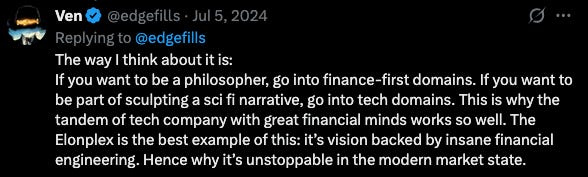
One of my favorite things to point out is that tech visionaries dream of being sci-fi authors, while finance luminaries dream of being philosophers. The math/physics split works out the same way — finance is an applied philosophy domain which is encompassed in the language of math, where the abstracts are converted to quantified risk and profit is generated out of the system, while physics operates in a more grounded realm of “what’s possible in the ruleset” and expands as much as possible. The obsession with the infinite, rather than what’s possible, leads to the concepts of “countable infinities”, defining randomness, and figuring out whether or not we actually live in a defined ruleset in the “real world”, rather than construction and expansion. Inherently, this makes one a skeptic, and biased towards doing nothing at all, as opposed to the doers of the world, the best of whom work backwards from what a solution to a problem is, then find a way to make it fiscally workable.
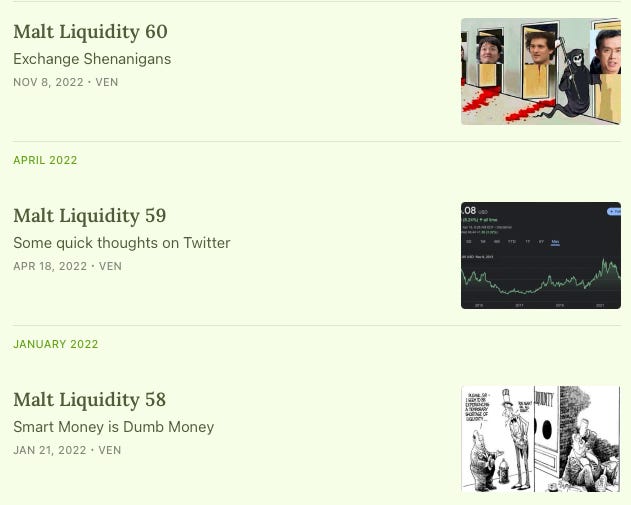
Another great part of documenting my own lifestyle nonstop is that I have an exact record of what I was thinking on any given date, to the point where I know that if I’m not writing, I’m not healthy. Case in point:
My first readers thought I had given up on blogging, which would be the natural conclusion of this kind of posting break. But the context behind this gap was a period of serious burnout, to the point where I could not form coherent sentences, after coming down from a crazed trading mania from ~August 2020 onwards. After that blog post, I started taking some pretty heavy antipsychotics to try and get my brain “on the map” again. As anyone who’s taken antipsychotics might recognize, this essentially lobotomized my entire right tail memory and word generation ability, and the pithy attempts to write while I was on them can be observed in this sad attempt.
At that point in my life, I didn’t have a little, but I certainly didn’t have a lot, in a place that a lot of upper middle class kids find themselves after college (although I generated the money on my own) — comfortable enough to not have to look at a check when I went out for dinner or traveled, but not even close to enough to never work again. Worse, I had no resume, no prior job experience, and I was drawing down on my capital to exist, and had nothing to actually do. This is precisely the kind of person who ends up in law school.
It sounds very odd to say this, but I get a sort of “premonition” when major financial events are imminent. Every great discretionary has a tell — George Soros got back spasms, Bill Ackman gives interviews while nearly in tears or posts about how the world is ending,
and I manically write until my brain exhausts itself from working out the possible outcomes.
To this day, I don’t exactly know how my brain unlocked from the lobotomized haze that the antipsychotics put me in. Even when I quit taking them — at the exact time I was posting “quick thoughts on Twitter” — my brain was still locked in a chemical box that I didn’t quite know the path out of. The reason medication doesn’t work for exceptional people is that your memory doesn’t go away. More than intelligence, exponential memory is usually the ability that pushes people to outlier territory. I firmly maintain that I would probably have preferred to be lobotomized from that end-2021 state if my memory was wiped as well, but instead, I was stuck in this kind of perpetual state of cruelly being reminded that I wasn’t doing what I was capable of, but numbed a bit too much to care.
The straw that broke the camel’s back was around that blog post as well. Figuring I might as well take a job, I applied to some old trading roles that I turned down out of school. And while I was a final-round mainstay out of school, I found that the medication had pushed my mental math ability to decidedly ordinary levels. I wasn’t able to even hit 70% of my old rate. It’s one thing to be a former athlete, or retired, but I was 23 years old at the time. These experiences from 2020-22 largely shaped my psychiatry-skeptical viewpoints from back then. Figuring I was done for, I decided to take my hampered math abilities to law school.
Law school is a weird purgatory where people who want to change their life trajectory in the most risk-averse way possible reside. They sell it as a generalist institution, but so many people come in without any prior knowledge of anything “real”, and there’s this bizarre assumption that you can learn complex things from reading a statement of facts. Frankly, I found it easier than high school, having self-taught myself securities law from Money Stuff and scrolling court cases while trading, as it was precisely the level of mental expenditure that didn’t disrupt my ability to monitor the market. Within a week of school, I knew I was going to leave, notably proclaiming to a group of classmates in a game of “drinking Jenga” that I was the most likely to drop out. (A common theme of blogging your own life is that you also tend to script your forward events by framing the current environment.)
But dropping out arbitrarily is like being early to a trade. It’s still incorrect, and you don’t get to claim you’re right if you don’t have a reason to justify why you’re doing it. In the Biden regulatory regime, there was very little opportunity to trade or create. So I was content to enjoy my time in school and learn the industry, rather than how the law actually worked — if you could call this schizophrenic patchwork scheme that’s barely held together by scotch tape “working”.
That all changed when FTX blew up in the exact manner I predicted ages ago, and my brain “unlocked” again. A random position I had in a long-forgotten wallet cashed out, and, to some extent, I was back. In the month of November 22, I wrote 12 posts and thousands of words, as the spigot of thoughts unjammed. Which lead to what I think is the most indicative post in my entire archive, MacBooks vs Wristwatches (Jan 23).
The loudest critics of Elon tend to be the people who are plugged in to the events that go on around him rather than the people who buy in to the stories he tells them (ignoring the cultists — let’s assume that the following classes are filled with at least the semblance of rationality). I refer to this group of critics as the “MacBook class” — journalists and tech types who have the bandwidth, time and intelligence to have a lot of opinions on things, feel valid having them because they’ve reached a certain tier of society, and who tend to be the type of people whose opinions spread across the internet and the mainstream media. On the other side of things, we have a group I call the “wristwatch” class — the investors who aren’t concerned about what’s going on day to day, but rather what you can do to make them money.
For those who monitored my trading adventures, I’ve always lived as a hybrid between the two. Certainly, my love for wristwatches was the origin of that label,
the reason why I call the investor class “wristwatches” is twofold. One is because mechanical watch owners aren’t really concerned with efficiency, are they? The nicest Lange is less accurate than a $10 quartz Mickey Mouse watch. The other is due to how watches appreciate in value — take the Paul Newman Daytona for example. Functionally, it’s the same as any other Daytona — a watch that retails for around mid 5 figures — but due to the story behind the watch, it sells for roughly $18 million. The story itself multiplies the value of the same watch by 360x, which I think highlights the essence of how you understand the wristwatch class and, consequently, how you raise money from them.
but trading is not a function of buying into stories, rather, it’s a soberly speculative method of operating where your bets have to be calculated over time. It inherently halts an all-or-nothing thinker from making all-or-nothing bets, a chess-like training to take what you can get and not buy into cults, which is why I largely describe financial writing as a form of concocting fiction to rationalize the complex and unknowable (would you rather be profitable, or correct?)
Fundamentally, though, my form of trading is a form of journalism. I was clearly ready to play a different game than I did in 2021, but I had a problem of no resume to raise capital and not enough of my own to do anything on my own terms. But something chess taught me, as a kind of delta hedge against my 99.9th percentile ability to get bored easily, is that patience does matter, and that the moment to do things will reveal itself in due time. At 12 and 14 years old, I got stuck for over a year at the same ELO level (at 1400, and 2100, respectively.) In kid terms, this is an eternity, but knowing that I got over the hump in my formative years gave me a template for a) not forcing trades in a terrible market regime to trade b) waiting until I couldn’t control the urge to leave and do something else.
As the AI trading volume accelerated throughout 2024, I knew the time to drop the training weights and enter the fray again was imminent. Finally, on September 11, I couldn’t handle it any longer. I formally dropped out of law school — everyone’s dropped out of Stanford by now, I had to innovate somehow — and wrote the summation of what I had worked on for the past ~decade in Postmodern Society and its Future. The time to generate my own capital had come.
Part of what I understood in this “new” phase is that trading was solely a way to generate my own seed capital. If I stuck to playing the game, I’d never get off this “advanced journalism” method of having great takes and validating them through profit, but fundamentally staying an observer. Which is why I felt I relapsed in the Cracker Barrel episode, and it took a shock to the algorithm to stay the course.
Another indicator of outlier ability is intuitively understanding nonlinearity, which shows up as operating on multiple timelines:
To a rational observer, of course, [Elon]’s claims as to what the future will bring, his exaggerations of forward guidance and deliverables, and what, say, FSD is capable of seem like “habitual lies”. At the same time, when you are selling a vision of this level of abstraction and this level of complexity and opaqueness, I’m sure Elon doesn’t see it as lying, but rather the reality he deludes himself into thinking he’s creating until, somehow, it happens. Did a single other person see the EV industry and private space industry developing in the direction it did as clearly?
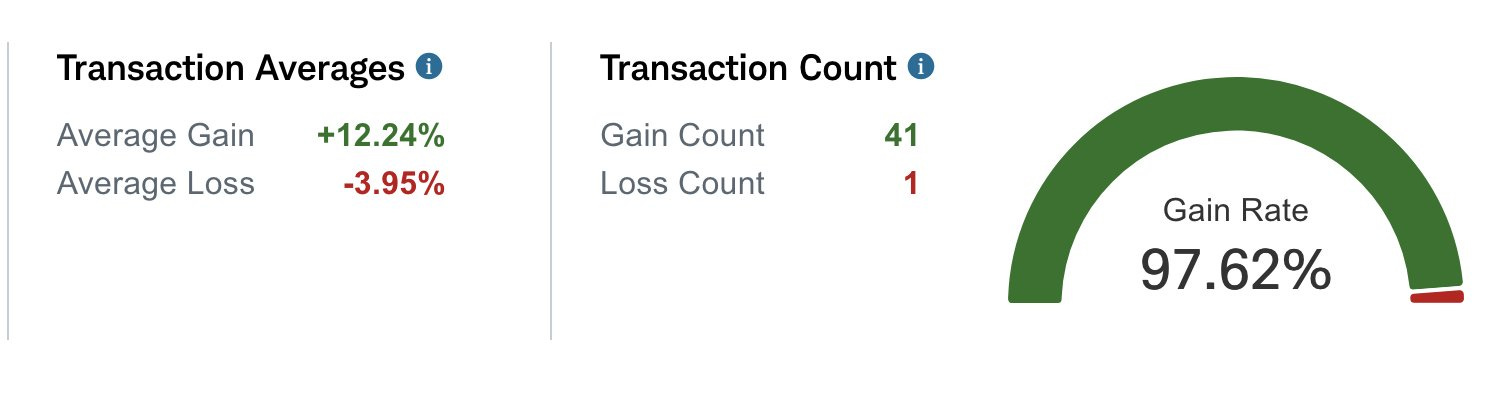
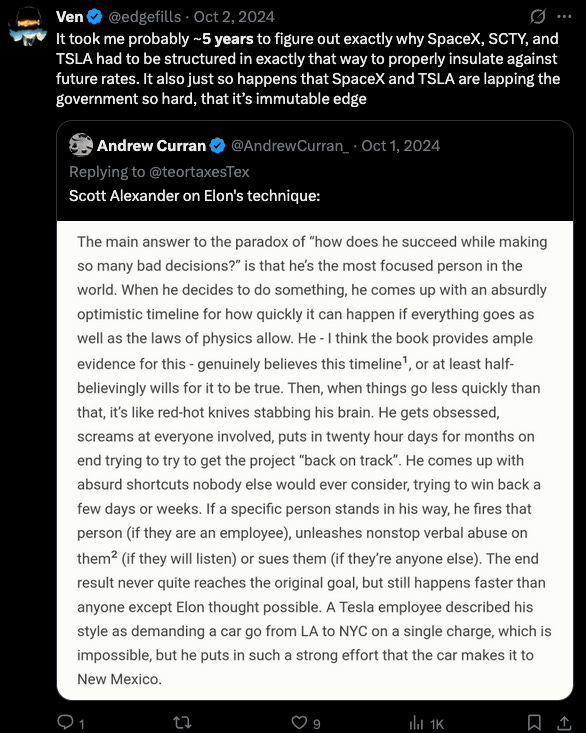
In my own terms, when I have a revenue generating process — trading — you can manage the liquidity such that your tail bets are not oversized and forcing you to draw down or compress your lifestyle (within limits.) If you own a bunch of these revenue generating processes that sync together where you can borrow/pass through the credit of the most stable one to the loss leaders to scale, well, you end up with a trillion dollar net worth. If I hadn’t taken studied model of TSLA/SpaceX/SCTY and written that blog post in 2023, I would never have bought in to space myself. Case in point: I had an essentially perfect year trading in 2025,
In the meantime, I’m in a bit of a transitional period. I have essentially nothing left to prove after a year of perfect trading,
and I’m sick of looking at screens after 11 years of being glued to them. Working for yourself is great — you always have perfect feedback, and you own what you keep — but the structure is limited in that you simply can’t scale your ideas without marketing them. And while it’s been great to be the person who can always say what I think for the first three decades of my life, it’s not going to ever move beyond the Malt Liquidity format if I don’t change things.
and yet, the nonlinear bets on space and a random trade I found from closely monitoring my X mutuals have paid more than all that work did due to exponentiation on longer timelines:
Disclaimer: I am still long
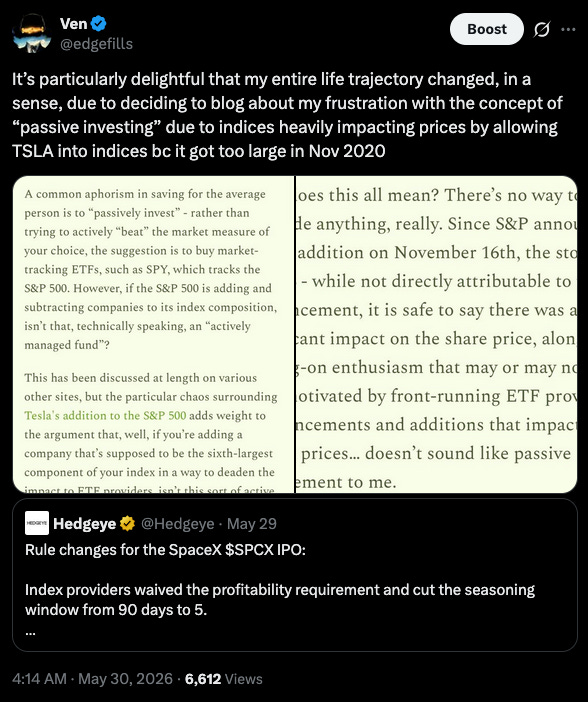
In the run-up to the SpaceX IPO, I was closely monitoring the technical squeeze pattern showing up. While this entire blog was borne from writing about the effect of indices on trading patterns with regards to, heh, Tesla back in 2020,
it was equal parts thrilling and vexing to see the prevailing retail narrative center around “SpaceX is using the indices as exit liquidity”. That “5 years later” time-to-validation seems to show up again, and again, and again in my life (and, indeed, is what I’m benchmarking my “tail bets” around.)
I’ve been around retail trading for a lot longer than 5 years, but there was a ticker that kept cropping up in 2024: ASTS. While I initially thought it was a meme stock — and I usually don’t trade those, because my gauge of sentiment, as a multi-timeline operator, is horrible in real time — further research and conversation with some trusted friends, and a growing belief that something had to change, led me to place that bet. Hilariously enough, I made 50% in one day, and actually sold my entire position as a result.
I originally intended to take a long term position over time in ASTS by legging in. Many, many people have been talking up this stock to me for months — I didn’t really pay attention until I got back from my summer travels, and realized that it was the real deal. (Of course, it had already run up a ton by then.) This, of course, meant that I was going to long shares — I wasn’t trying to time a specific move or trade around a catalyst. (Plus, IV is so elevated on the options already — the stock has 8x’d in the past few months — and due to [Thursday’s] move, vol actually went uprather than crushing, because, of course, the “true” catalyst is still a bit away.) When you trade shares, you essentially trade the risk of not timing the trade properly for the fact that you don’t get compensated for volatility on movement. (Hence “delta-one”, which options clearly aren’t.) So, a simple bit of deductive reasoning is useful — if I wouldn’t buy more at the current price, I’m going to look to flatten. After all, if I hold shares from 21 to 32 and then it retraces back to 29, what exactly did I gain for holding through the price movement, if I’m not going to add to my position? The prospect of long-term capital gains being 364 days away instead of 365?
And while I did trade in and out of the stock a lot, the goal of that trading was to effectively lower my average cost when I actually sent it for the long term.
I truly feel mastering retail trading was critical to taking these positions, as it’s essentially the perfect retail trade due to space being the most compelling narrative trade ever:
The problem with basically all modeling and valuation is that resources are finite. But to project anything out, it’s required to utilize something I call the “infinite growth assumption”. It works at a real world spreadsheet scale, but any big picture thinker runs into the same problem - especially with fiat, as growth reaches singularity, the only way to make revenue numbers go up is to literally print more money.
As to what I mean by singularity, I think Facebook is the best example. Once Facebook hits a critical mass of users, how do they make more money? All they can do is raise prices. This is extraction, it’s not value creation, and the track record speaks for itself in that they tend to incinerate a ton of this extracted capital with no real product or value created. And this is why, when central banks became the main driver of asset prices going up, along with indexing, the world gets worse while rich people get richer and wealth polarizes. The only way economic mobility works is to play more and more complex financial games to outpace inflation, which basically translates to gambling really well. Inflation is just too much money chasing too few resources — definitionally what happens when you print more money than resources can generate.
The only way out of this is expanding the resource base. The ocean is for thrill seekers, there’s no real way to get utility out of deep ocean. The other option is space. And Elon saw this over 20 years ago, when nobody else did, and more importantly, he bet on it. If you expand the resource base then growth reprices. And an IPO that’s successful means people who’d otherwise never think on this scale start to buy in. It means things can start to meaningfully improve again, and advancements can be made. Else we’ll be stuck having the same arguments of the past 15 years as everyone gets broker and angrier.
I’m inherently a skeptic, but I still remember exactly where I was when the chopsticks catching a reusable rocket happened. It makes you think things are possible again, and that’s when I truly started buying into the space narrative. It just has to work, or the whole concept of the dollar coordination thing fails. There must be real revenue generation to justify money printing at the end of the day. And if you really look into how beautifully SpaceX is constructed - attached to the government as a liquidity source, reusability, compute infrastructure, a satellite network to enable communication through the frictionless space layer - it actually works. And you can’t price that kind of multi-planetary thinking, we don’t actually have a way to define it in earth terms.
Which is why the SpaceX story is so compelling in a roadshow, and why everyone realizes it kind of has to work, so it does. Money just coordinates based on the math formalization of Coase theorem, which is game theory. All human behavior works this way, and believers vs nonbelievers essentially works out as long vs short a stock. But stocks are designed to go up, so they lose as long as the plan is executed correctly, because valuation is never the reason a stock goes down — revenue is the only fundamental, and stocks only go down if there’s no bid.
Sounds like a culmination of every theme I’ve ever written about, and all the problems I’ve highlighted over the years, right? “Fuck it, let’s do it from space” is legitimately more realistic than California ever reforming from within.
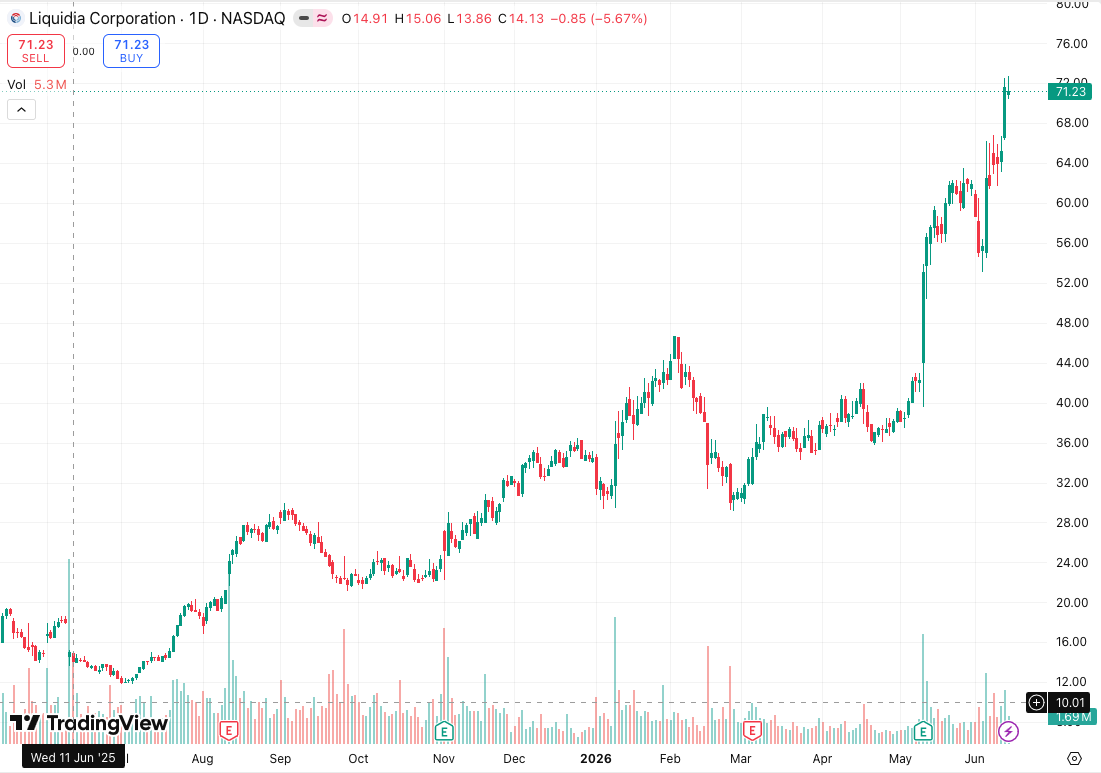
The thing is, when you’re up a ton, when do you know how to sell? Private markets are for true believers — “equity provides liquidity to hope” — but public markets require timing. And in what was possibly the greatest technical squeeze setup I’ve ever seen in a position I’ve held, the sell sign was maybe as literal as it gets:
I haven’t sold a stock on open in 5 years, yet when I was at a party, watching this explosion like Roman in Succession,
I knew that the squeeze was over. While the structure of space stocks is fundamentally different than meme coins or crypto rugs, because there is a very real, tangible product being built, explosions like the blue origin incident remind people that it’s extremely finicky to test these rockets and the narratives do contain a lot of hot air. The trade, quite literally, ended with a bang. And after cashing out, I did what I always do after an arc ends — I buy a watch, and I write a blog post.
I’m still heavily sold on the space narrative because “silicon god” is an unappealing use of my Pascal’s Wager. SpaceX’s IPO not blowing up the order book and trading 500mm+ shares is a sign that nobody’s given up on it. But the liquidity is better used on other ideas of mine, by building my own Venplex in the areas where I think the next scalar exists: bringing abstract systems such as money and law into an expanded resource method of thinking — particularly what happens when you have information hyperprocessing agents. It's the only real reason I took liquidity from space stocks and am putting it in my own ideas and network. Last month, I wrote my first venture check ever regarding The Future of Finance. Next month, I’m launching my own wealth advisory practice, because the only way a model gets better is with more training data — in this case, understanding how to scale my financial philosophy beyond my own intuition. And that’s why I can confidently say, while rocking my new earth-rock space-rock Day Date,
I’m a wristwatch now, bitch.
In the coming months, finance content will move to the wealth management website, while the more personal-oriented writing will remain here. If you’d like a mention when I start posting there, please send a note to me.