Exactly 1 year ago, I was speeding through New Mexico moderately perturbed about how the modern information environment essentially made it impossible for me to unplug,
Unfortunately, I can’t unplug — not only is a new information environment the most addicting on earth, but absorbing this berserk flow and managing risk at the same time is incredibly taxing, but required of how I handle things
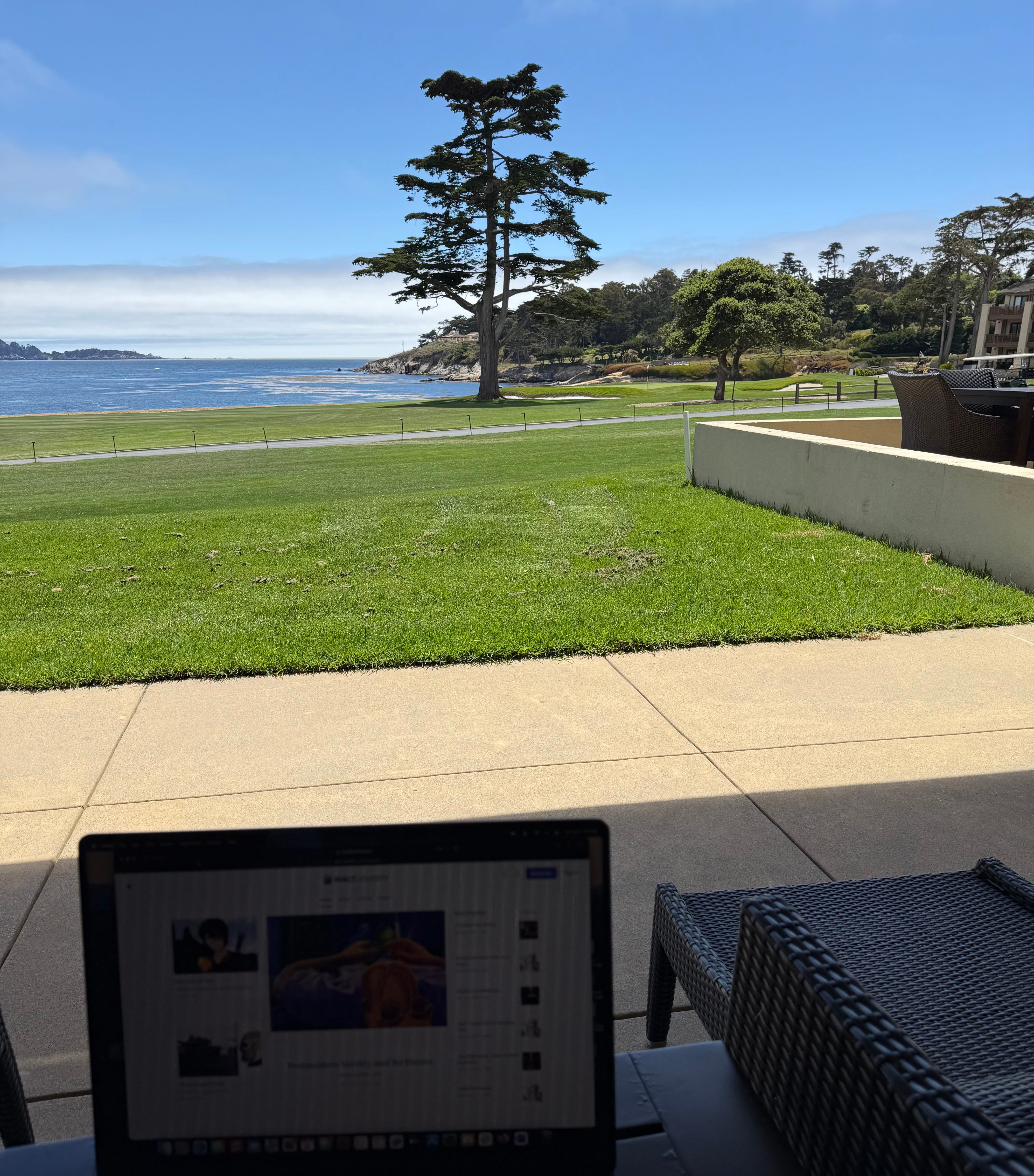
when I stumbled across a golf shop in Albuquerque. Figuring that I had nothing better to do, I wandered in, perused the wares, and walked out with a heavily discounted, lightly used set of Ping irons. As I slapped some balls around in an abandoned hotel resort driving range 20 miles north, I decided that the healthiest way to get myself touching grass again would be to hit balls off it, and set myself a rather insane goal of breaking par at Pebble Beach.
Originally, I wanted this post to finish the “retirement arc” from May 14 to, er,
now, as an example of how to “learn” activities where there isn’t a rigorous pathway forward (from chess, to trading, to golf/life.) Instead, I found myself standing at the 2nd hole tee box at Pebble waiting to hit and wondering what the fuck I was doing with myself
One year and countless hours of gear-heading later, though I obviously didn’t manage to come close to that ridiculous goal by mid-July, I’m hovering around a 10 handicap and finally have a complete bag for this year, and I don’t think I’m even close to playing the best golf I’m capable of. What follows is a recollection of the dramatic mental shifts I experienced by using life to get good at a game, and a lot of reminiscing.
The Early Years
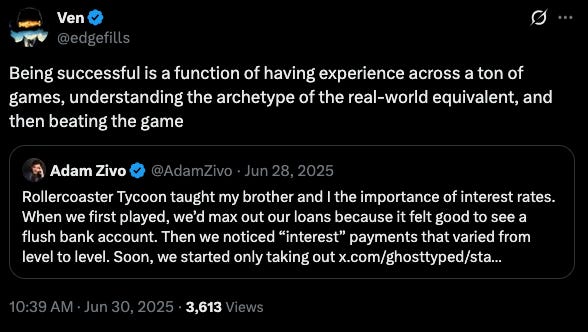
A mantra I’ve understood since I was a teenager is “if you’re good at the game, you’ll be good at life”. Most people misunderstand this as “game skills translate to real life skills”, which is not the case. The process of becoming skilled at a game allows one to construct a parallel to a real-life situation that can then be gamified, turning the abstract concept of “getting better” into an iterative process of improving over time, which is why I constantly talk about how chess imparts the concept of “deep learning” onto a kid. “Git gud” is probably the most important experience for kids to have — while grades are arbitrary, political, and essentially meaningless nowadays, winning in a true competition cannot be faked. You did it, and were rewarded directly for it, even if the stakes were meaningless. This kind of validation breeds a youthful self-confidence that clearly distinguishes people over time. Consequently, the more abstract the process of “getting good” is, the higher the potential is to take it off-grid and to the “real world”.
While the remnants of my childhood achievements are mostly centered around chess, I’ve always been good at anything I set my mind to. (Indeed, after medicating myself for ADHD, I realized that I essentially lived ~28 years with some form of learning disability.) In school, this included sports up until age/genetics differentials from skipping grades factored in, bar games like table tennis and pool, and in the extracurricular world, I was a pretty accomplished classical pianist. My League of Legends skills peaked in college (as my grades tanked, naturally), but I was never bad at games outside of first person shooters. I’ve never quite solved why I was so terrible at Counter-strike, but I suspect it’s something to do with uneven vision between eyes messing with my depth perception. I think I’m past the point of getting Lasik to play video games better, though.
The game I really wanted to play, however, was golf. It was the age of peak Tiger Woods, and I must have spent thousands of hours on my Nintendo DS in between chess tournament rounds maxing out my career in Tiger Woods PGA Tour. When I watched the game on TV, in the naive manner that’s only present in children, I assumed that I could be good at the actual game because it just sort of “made sense” in my head. While my dad refused to play into the delusion — brusquely saying that “golf was for rich people” and that my weekends were for chess, rather than leisure — he did acquiesce and put me in a local golf camp that summer, which was so poorly coordinated that the staff ran out of right-handed putters during the greens session. (I still swing righty, putt lefty to this day.)
But my delusions about my golf prospects were very much grounded in intuition. Having given up chess a long time ago, I firmly maintain that the closest thing I’ve experienced is playing golf. It’s very much the same combination of varying “moves”, keeping a steady mental state, optimizing contextual consistency, and using referential memory and pattern recognition to shrink the margin of error. Except instead of sitting in a hotel ballroom, you get to take a scenic walk and socialize, where the stakes are essentially self-constructed. On some level, I had “solved” the game internally already, while most people never progress past slapping the ball as quickly as possible to the hole — which manifested itself through sports betting when the competition passed me by in other games — I just had to learn how to play it.
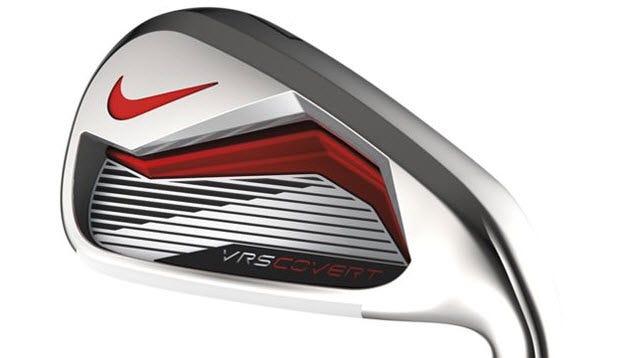
There are certain rites of passage in the United States that I hope never dissipate, and one of those is your parents being unable to tell you what to do with your money after you turn 18 years old, and I was finally able to buy my own set of golf clubs. Of course, being the Tiger fanboy that I am, I gravitated towards Nike (back when they still made clubs), picking out a set of Covert 2.0 irons and a Method putter at the infamous Palo Alto PGA Superstore. As I checked out, the cashier remarked that the last person to buy that set of irons before me was none other than Jerry Rice. Enthused, I immediately drove over to Stanford’s driving range to test them out.
This is the point in the narrative where you might think that I realized that golf is a lot harder than I thought it would be. But as an early adopter of learning things off YouTube, I had a pretty good idea of what to expect out of the gate. What I actually learned is that I do not have the build of Jerry Rice or Adam Scott, and without clubs that fit my profile, there was virtually no way to hit a lower iron reliably. In the next three months, I proceeded to design a method of playing golf with 7 clubs: Driver, 5 wood, 7 iron, P/54/60 wedges, and putter. Since contact is king as a beginner, I figured that varying the club position and swing on the clubs I hit the best made more sense than trying to hit a bunch of clubs pristinely every time. Thus I learned to hit a 7 iron 7 different distances, which is totally orthogonal to general wisdom, but was a strategy that I was confident in. After all, the problem with general advice is that it’s general — optimized for the normal distribution — when statistics don’t apply to individuals in a population. Golf is a solo game, so you’re going to have to figure out what works for yourself. Much like the end result of checkmate renders the path to get there moot, the only thing that matters is getting in the hole in the least strokes possible.
This all culminated a few months later in a corrupted round that probably showed flashes of my actual potential. I was playing with a couple friends at Sharpe Park in Pacifica (known as “the Poor Man’s Pebble Beach”, or in this case, “the drunken college kids’ Pebble Beach”), one of whom was a scratch golfer at the time. In classic muni golf fashion, I showed up right at our tee time, already tanked on two tall boys, and proceeded to obliterate the ball over and over. On hole 3, I holed out from 145 yards for eagle. After 5 holes, I was 1 under, lowest score in the group. After a wayward drive on hole 6, while searching for my ball under a cluster of trees, I got attacked by a group of bees and stung multiple times, truncating my channeling of Daly as I left the course to get treatment.
The beauty of golf is that when it all clicks, there’s basically no other feeling like it on earth. Professional athletes, gamers, racecar drivers, traders, and more talk about the flow state, but golf is one of the few activities where it’s randomly accessible to the layman. At the time, breaking 100 was a great round by my standards, yet for 90 minutes, while barely able to stand, I could do no wrong with a club in my hands. In every other instance, an extreme amount of effort and skill building is needed for those pure flow moments to be executable — hence why the vast majority of golfers are hackers yet keep coming back for more. It’s the rare activity where I know it’s essentially impossible for me to have a bad time and lose my temper, which is why reading passages about my mental state during the Pebble Beach rounds clearly indicates to me that there’s something else going on mentally.
What spoils the loop is perspective. When you know that you’re playing a board game with no meaningful reward, it’s impossible to properly apply pressure to motivate yourself to find the best move in a position. When you know that you’ve reached the limit of noticing the number going up in your bank account — the studies stating that “increased salary does not bring happiness” are absolutely true, just look at where people predictably hop off the salary/self-improvement treadmill — mispricings stop looking like opportunies and instead look like crippling social idiocy that you can’t just go and fix yourself. It’s not quite the Daytona 500, where they are literally driving in circles, but I finally get the meaning of Twain’s quote about how golf is a good walk spoiled — what spoils the walk is the realization that you don’t have anything better to do, that you’re willing to fuel the money sink to pass the time by modifying the walk in a pointlessly complex manner.
When I reread this post, I can literally see myself as the Underground Man, which, in reality, is textbook depression. While I think that everything I wrote is accurate, it’s inevitable to wonder what the hell that guy’s problem is.
The last round I ever played with those Nike irons was in 2020, right after Morikawa won the PGA at Harding Park. I got to go on the course with my buddy who worked there, having not hit a shot in years, and play in the major conditions. It was a disaster of a round, me being in the throes of pandemic depression drinking, compounded by the fact that a ball was lost if it trickled anywhere off the fairway. But even though I barely finished most of the holes, the good walk wasn’t spoiled. You are the only person that can spoil the walk for yourself, because how could one possibly be bitter about a day outside with friends, instead of working?
In part 2, I’ll cover the years of rental clubs on vacation, sobering up on the course, and actually seeing if I can execute beyond “gifted kid” syndrome.