


The thing I enjoy most in the world is confirming my intuitions. The thing I enjoy second-most in the world is playing games.
One of my core beliefs is that if you are good at the game, you will be good at life (and you can read this fantastic Conrad Bastable piece which goes into much greater depth on this phenomenon) :
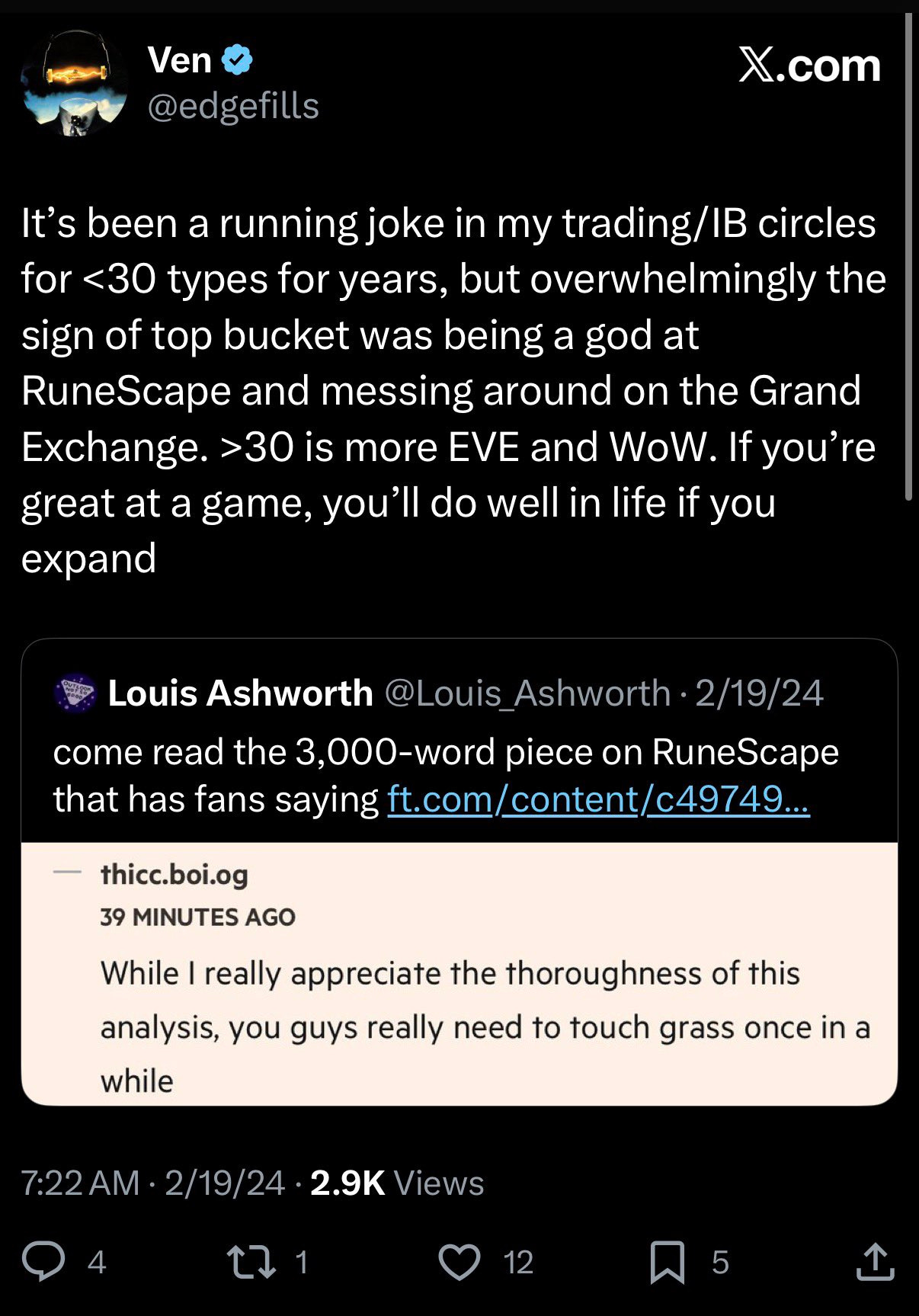
Indeed, the halls of high finance and tech are littered with chess masters, D1 athletes, League of Legends challengers, 99 woodcutters, and more.
At some point, though, even the best gamers have to walk away. And while I’m not a fan of the mass sports betting push, it would be more than a little bit hypocritical of me to say that you shouldn’t bet at all. After all, I helped run a sportsbook in college, and have wagered on pretty much any esport and sport I’ve bothered to watch in the past decade, due to the simple fact that if I’m profitable, I clearly understand something about the game that others are missing. (Indeed, there’s deep lore from my senior year of college, where I decided to bet on League of Legends full time, turned $200 into $20000, and got banned for moving the offshore book so much. They cashed me out in BTC, and it promptly doubled.) It’s my own way of playing Head Coach 09, or seeing if I can process the game in a similar way to those with the superhuman genetics to actually play it.
And, if I plan on managing other people’s money, responsibility dictates that I follow my own principles of financial responsibility that I recommend on others. The same lessons I learned from managing sports bets are ones that I scaled to a much larger degree in the options market — any “advantage” to be gained from disguising flow and other strategies in the sports markets has a hard cap on how much you can make without going full Billy Walters. It’s simply not worth spending time on sports when you hit manual review of your bets. But the examples are more grounded in reality in sports, as opposed to the hall of mirrors that is financial markets, and I hope that my philosophy is useful to consider.
(Note: the following is centered around football, but I’ve replicated this in at least 5 different sports and 2 esports.)
1. What is a sports bet?
I’ve written previously about how option mechanics tie into odds and can even be used to make actual game time decisions, but we can go even further with the comparison. I split sports bets into two categories: live bets and parlays. Each live odd is essentially a zero-day option offered at an individual strike price, while parlays are a structured product made up of multiple zero-day options.
2. Understanding straight bets
The most common mistake I see when people try to strategize their betting is that they get trapped in the world of statistics and expected value. From a first principles perspective, it’s kind of silly to think that a given team’s aggregate statistics apply to an individual matchup, where a bunch of variables come into play in the independent event that simply can’t be priced in. Our edge in sports comes from variance in the system, aka the game state shifting over time. Playing “statistical edge” treats a dynamic system like a static system — the rules of blackjack, for example, are fixed, so you have a fixed statistical strategy with very minor fluctuations based on the cards that are being dealt. Sports are nowhere near this predictable! The only “edge” the house has is the vig — the small fee we play to place a bet. Thus, we should look at the offered odds as an indicator of potential flow rather than an expectation of where a player’s statline should end up.
Not all lines are created equal. Similar to “at the money” versus “out of the money” options, the difference between a spread bet and a moneyline bet, in the case of one team being favored over another, is essentially the equivalent of buying a 50 delta option versus a low delta option. (Placing a bet is always going to be the equivalent of buying an option, given that you lose the premium paid if your bet loses. There’s no good way to “short vol” without taking a gargantuan amount of unnecessary risk.)
This brings me to my first rule of straight bets: always bet underdogs. The idea is pretty simple:
In options theory, there’s a concept called “put-call parity”. In very simple terms, risk exposure that can be constructed through calls must be replicable through puts, because otherwise there would be an arbitrage available.
In sports terms, it means that if we assume that the book is pricing odds efficiently on both sides, then there’s no real difference expectancy between betting the favorite or the underdog. The only thing that could shift the expectancy is flows, which is why I love underdogs — people are biased towards betting less on the longer shot, taking comfort in the “favorite”. At obvious inflection points — when a team scores, when there’s a turnover, odds rapidly shift towards that team because the human inclination is to trend follow, rather than be contrarian. Sports are not blackjack. Anything can happen, and as teams get increasingly efficient, reversion to the mean comes much faster than the kill-the-clock protect-the-lead days.
We also have to keep in mind that the priority of the players and coaches is not covering spreads or hitting certain metrics (unless you’re in the NBA…), but that of winning the game. So our rule of betting on underdogs leads us to two more principles: never bet on the end result of the game, and bet more, not less, when the odds are longer.
Much like an option’s gamma going to infinity at the moment of expiry, variance is simply too high as the game reaches its endpoint. The goal of any underdog bet is to capture the reversion (and either hedge on another book or cash out, if your current book allows it) as the reflexivity of priorities and pace-of-play changes, not to hold out hope on a miracle comeback. And this is why we bet more when the odds shift rapidly against a team:
An underdog bet is the equivalent of the book offering cheap leverage to attract balancing flows on both sides of the book. (Though it can never truly be the case, the basic goal of a sportsbook is to collect vigs, not take directional risk.) If you watch the odds enough, you’ll see the massive spike when a team immediately scores, and then the odds will “settle” as liquidity provision tightens the spread.
What I like to do in these situations is slam the book. If there’s a spike to +900 in the live odds, the normal human’s inclination is to bet a very small amount as they’re focused on the end payout. What I’ll do instead is bet 100x that amount and look for the odds to compress and cash out on the slippage. (This is why manual review kills this strategy — your bets only get placed after the odds are reviewed, and this entire slippage capture is hard-gated.) Accordingly, this is why my next principle on straight bets is to never bet against yourself, aka hedge. I don’t mind paying a small fee to cash out (or make an offsetting bet on another book, locking in profit), but hedging in a sports book is about as inefficient as it gets (defined here as making a contrarian bet to your original position, so if you lose one, you win the other.) Unless your “hedge” is directly offsetting your current exposure, all you’re doing is paying a fee to inefficiently cover some risk on your original bet. If you’re uncertain about whether to let the bet ride, just cash out and lock it in! There are always other games to play.
3. Understanding parlays
While I think anyone can learn to bet live odds like I do, parlays are a little more complicated (and that’s why the house edge is much larger.) While you don’t have to literally understand multivariable calculus, constructing a structured product of multiple options on a game is very much an intuitive mathematical exercise. But every bit of parlay construction builds off of my principles from above, and with some patience, I think the mindset will at least save you from making bad ones more often than not.
The most common mistake I see ordinary people make when constructing parlays is that they treat it as a series of coin flips. Remember, our edge against efficient odds comes from leaning into variance. If you are picking bets that are roughly 50/50 (and paying a vig), for a four-leg parlay, you essentially have to win 4 coin flips in a row.
We want to lean more into correlated outcomes and pairing low probability outcomes with high probability ones. Remember, we don’t want to win on the end game result — the ideal parlay has a longshot leg that knocks in very quickly, repricing the rest of our product dramatically.
Of course, sportsbooks are not stupid. If you pick correlated outcomes on the same player, they will dampen your odds — if you have the Christian McCaffrey over on total yards, it’s pretty likely that if he hits that yard total, he’ll also score. If you pay attention to odds pricing and do the math yourself, you’ll see that paired outcomes are not true combined probabilities.
This is where game knowledge comes into play — I call it having a script. Much like a coach might develop a specific gameplan for a team, I get an idea of where I think the game will go based on the at-the-money straight bets and my own knowledge of the game. Every leg of my parlay (I usually stick to 3 or 4 legs, after that the penalty of depressed combined probabilities becomes too high) will center around this script. If I think a game is likely to turn into a shootout, I’ll pick a longer shot scorer, an artificially low over/under total compared to the ATM line, and some stat totals that correlate with both these outcomes on individual players (NOT the same one.) Basic fantasy football logic can be used — if the QB is throwing a lot, his WR1 totals are likely to be quite high. If one team scores quickly and builds a lead, the other team will speed up as well. These are examples of correlated outcomes that are still independent enough such that you’re not getting punished for combining them in a single bet.
The last principle I’ll share around parlays is understanding leverage. Why would I take an artificially low over/under line in the prior example, as opposed to the straight bet pick’em line if I’m pretty sure the game turns into a shootout? Well, the goal of parlaying bets is to reduce premium outlay for more efficient leverage and to avoid coin flips as much as possible. Instead of betting solely on a WR scoring, I can add a leg that’s fairly likely to hit with my predicted outcome while amplifying the payout by a small amount. I add a bit of risk for the benefit of reducing the amount of my bankroll I have to outlay at the start of the game (which I’ll explain more in the next section.)
The end result usually looks something like a 3-4 leg parlay between +300 to +650 payout that wins by the third quarter, ideally by halftime if everything goes well. Again, I never want to bet on the end of the game if possible, due to uncontrollable variance.
(Seriously, it’s exactly the same as zero day options trading.)
4. Combining it all
Risk management is not a function of winning all the time, but about controlling drawdowns and not chasing losses. I like football because I can bet across the day through the full slate of games and vary the amount of risk I take based on how earlier games have gone, but the principles can apply to individual games as well.
For an individual game, I’ll have a maximum amount I’ll bet over the course of the game. How I split this bankroll between live bets and parlays depends on two things: how confident I am in the script, and how lopsided the game flow is. The key to managing multiple forms of bets is to never bet against yourself. If my parlays depend on a shootout, I’m not going to bet the under, no matter what, over the course of the game. The key to profitably betting over time is not to chase losses in the opposite direction because something isn’t going your way — that’s paying the variance tax, rather than benefitting from it. The ideal scenario is one where all of our live bets and parlays can win together — many times in my life, a game has started off slow, and I’ll find live bets that correlate with the parlays I want to hit. Maybe I’ll double down on an alt line if it becomes the live line. The key is to create one tiny loop where all your outcomes can hit together, preserving that far right tail which pays for your bankroll many times over rather than eating vig loss after vig loss and creating that hole on the left tail where all your bets blow out anyway.
For a slate of games, I believe in the compounding rule: I believe in being extremely risk controlled until I’ve doubled my bankroll. From there, I’ll bet much heavier on games later in the slate — my max loss is still what I was prepared to lose at the beginning of the day, but as a result, I’m creating positive skew for myself throughout the day. Variance is a friend when you are long volatility (eg paying premium for options.) You want your best days to exponentiate many multiples over and “gap up” — you can’t be the house, so you can’t make steady money over time in an efficient way. Betting more when winning is the single best psychological advice to win as a discretionary gambler/trader — mathematically the division is arbitrary, but psychologically, the effect on your confidence is massive. Playing with house money and hitting a +900 line in size is much easier than sticking to a Kelly-sizing strategy, and it’s way more fun to hit a big bet anyway. This is gambling after all, you have to ride out the peaks and valleys in a human way.
Alas, that’s my final principle: bet with your head, not over it. Sports betting is about being rewarded for the knowledge you’ve accumulated in a given game, not about getting rich quick, or paying the bills. The ultimate power in life is knowing when to walk away and know when you’ve played the game to your heart’s content, whether it’s chess, League of Legends, tennis, whatever. Nothing good comes from endlessly deluding yourself that you can keep improving past the point of diminishing returns.
Anyway, that’s my annual Super Bowl gift to y’all. That’s probably why I fell in love with the art of wagering in the first place — I get to take the narratives in my head and see if they’ll play out. I’m expecting the Seahawks to win comfortably, Darnold to get the MVP, and a whole new era of “is he Hall of Fame worthy?” debates to be had in the next decade.