

Once Upon A Time With a 7-Wood
My Year of Golf and Relaxation, pt 2

The hardest part about walking away from a game you’re great at is figuring out what to do next after recovery and relaxation has occurred. My golf rounds when I’m paired with someone under 50 that isn’t in sales are filled with the same conversations over and over, where a gap up has been hit, comfort has been reached, and the risk calculus that pushed you into success has shifted, where motivation wanes as running the same track over and over again seems highly unappealing. And if you look at my posting about “retirement” over the past few months, that existential dread ebbs and flows throughout the days, hanging lazily overhead like overcast clouds on a 40 degree day. It also makes it hard to write regularly — if you’re not systematically monetizing the attention flow in the algorithm or captured in its wave patterns, there’s simply not a lot that goes on. The higher you place yourself in a process, the less impact the 24 hour cycle has on your thinking patterns.
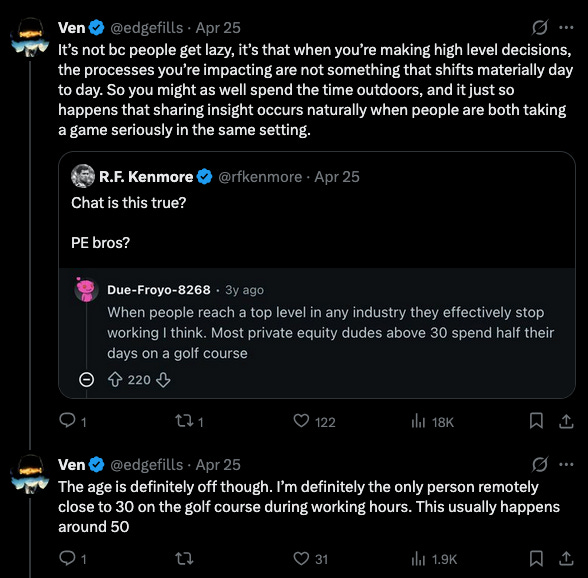
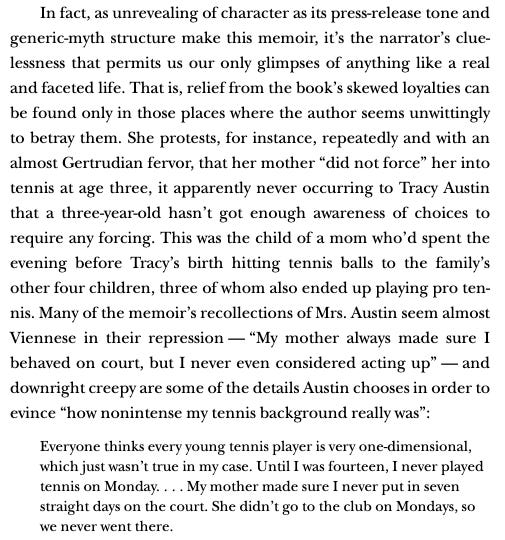
Golf is a great honeypot for obsessives of a certain variety, but it’s simply not enough intellectual stimulation. It can’t be a full time lifestyle unless you’re old enough to actually retire, which is why the smart people I see at daytime bar hours who are clearly going insane are either people who sold their business and don’t want to work again, or former professional golfers. They’re desperately seeking 80% of the same hit without the physical and mental costs of chasing the top, just like I am. But balance simply doesn’t exist at the highest end of any activity, which is also why I’ve come around to the oldhead take that amateurism is the true form of games — professional sports are unhealthy obsessions turned into awestriking spectacles. The reason sports are considered “children’s activities” is not because it’s childish to play and enjoy a game, but only a child could get obsessed and master something without stakes being involved. As an adult, I could never obsess over chess like I did after learning the game at 4, just like Tiger Woods wouldn’t be Tiger Woods if he wasn’t swinging a golf club before he was sentient. You can’t choose to be enthralled with an activity, as one of my favorite David Foster Wallace essays about Tracy Austin highlights.
I have been good since acknowledging my failures to properly detox from trading during the Cracker Barrel saga, and have not relapsed into using my yearly return % as a benchmark for how my life is going. I don’t look at the market at all when I golf, and I’m totally unconcerned about the intraday movement. In a sense, I’ve finally reached the end-stage investing mindset I was deriding all those years ago in Moth Liquidity.
The vast majority of money that moves in and around the market is based on the philosophy that whatever is invested in will create future cash flow rewarding current shareholders, who hold a right to their share of the output. When this money sloshes around, it creates market impact, which in turn creates trading opportunity. Note that these investors generally operate with a philosophy that they don’t want to react to day-to-day market movements. They are in it for the cash flow created over time and the movement in share price that will reflect that.
But the flipside of being excellent at doing things is that you tend to be terrible at doing nothing, and trading was largely an all-consuming lifestyle from ~20 onwards for me.
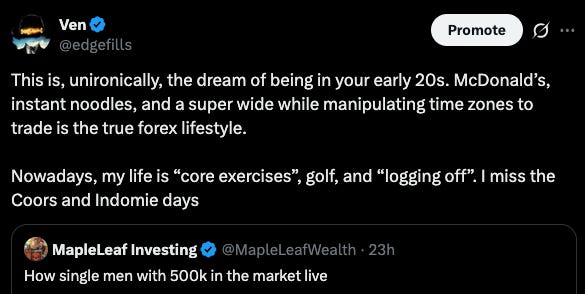
In a corporation, where the people in the process need to stay sufficiently motivated (I say about ~30% productive) to not burn out before actual work has to be done, deadlines are set to induce the “lock in”, which is why retiring early is so dangerous — having to generate this process yourself is exceedingly difficult and can lead to manic, overly risky behavior or substance abuse. As I’ve documented on this site, quitting trading is even harder because of what you have to do to yourself to survive doing it. Everyone thinks gambling or trading is luck, but it’s much more like being a professional athlete. It requires more work, attention to detail, self awareness, and honesty than any job could demand out of a person, because you can’t fake a PnL. When you lose that tether to value, you have to redefine what value is, because you’re used to moving around sums of money that other people would find life changing, and it’s uncouth to revel in being rich. (Plus, once you have a paid off place and enough money to pay for hobbies and dinner without looking at the number, there isn’t really anything else to do. The responsible financial habits that got you where you are preclude you from being irresponsible with money sinks.) The “trader retires to contemplate God” pipeline is very real, but again, this doesn’t exactly fill up your days.
What follows is a 100% true story about how I tried artificially generating some stakes.
The funny part about professional sports is, beyond the salaries, it’s fundamentally a form of gambling. Some sports cloak it behind salaries and sponsorships, but there’s a reason why they call them “contract years”. It’s a bet on your talents being validated by money and trophies. Golf, on the other hand, is pretty up front about the whole thing. Each stroke is essentially a five-figure bet, with exponential rewards as you compound them together, which is why golfers are extremely autism-coded. They try to control as much as possible because execution is the only thing they can control in the environment they place their bets in.
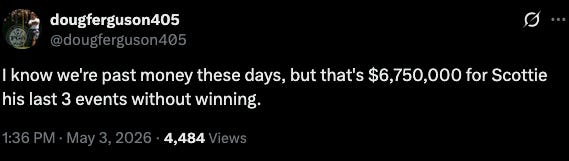
Trading is extremely similar in this manner: why the best traders/firms are obsessed with systemizing things is bc the market already has uncontrollable variance. It only makes sense to fix every non-variable factor as much as possible.
I’m not good enough to gamble on golf — I play friendly “matches” with competitive high school/college golfers (more on that in another post) to see how my game measures up and figure out how to improve, but that’s about it — but I am a pretty good gambler, having wagered on basically everything under the sun at some point in my life. So, when I had to go to Vegas for a fingerprinting appointment — literally a six minute endeavor, but it had to be done — I figured I’d turn what would otherwise be a mundane same-day trip into a “toss my clubs in my trunk” adventure. The plan was to play a few rounds on the mountain route to Vegas, then hit the poker room to win my greens fees back.
The risk here wasn’t exactly monetary in the golf portion — it was more a test of my physique, whether the regimen of “core exercise” and simulator practice would hold up for four straight days. I wanted to get in the head of a competitive golfer who played 4 days a week minimum and practiced the rest of the time — did I deserve to use the Tiger Woods comparison when describing my own obsessions over markets, because I certainly wasn’t that diligent about chess — and boy, did I learn that playing that much golf is hard. (Though with less driving, and with my shipping-delayed new driver, it might have been easier.) But my back did hold up, though there is more work to do.

My first stop was in Page, at Lake Powell National. I think I could have booked the twilight rate, but min-maxing green fees wasn’t the goal here (especially because I was going to win it back, of course.) My game is essentially built for these high-elevation regions — even without a driver, I was comfortably crushing the ball well enough to play mini driver/7 wood/wedge golf and played the best scored round of the trip. If I had a bit more experience with the course, I absolutely would have broken 80 here. But this exposed the biggest flaw in my game — having gone from 7 club golf in HS/college to a fully fitted, custom bag as an adult bomb and gouge player, I was absolutely wrecking my scorecard with inconsistency having to hit irons on par 3s.
For $79, it was unreal value. I played completely alone, and if I didn’t have 3 more days of golf ahead, I would happily have played 54 holes for probably <$150. It’s a bit out of the way of any major city, but wow, this was one of my favorite tracks I’ve ever played.
Next, I made my way to St. George and played The Ledges. Honestly, if I ever actually bug out and permanently log off, I’m living in South Utah. Beautiful views, unlimited courses to play (next time I go out, I’m going for the Black Desert experience), and friendly regulars are everywhere.
I got paired with a women’s college golfer, and I kept a hole tally going. Now, experience from being paired with college women’s golfers as a kid taught me that you actually learn more from watching them play than watching PGA tour golf.
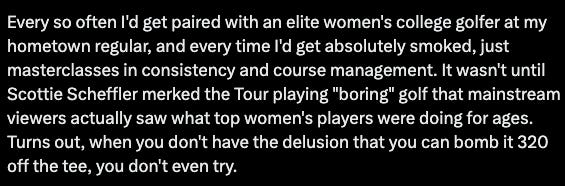
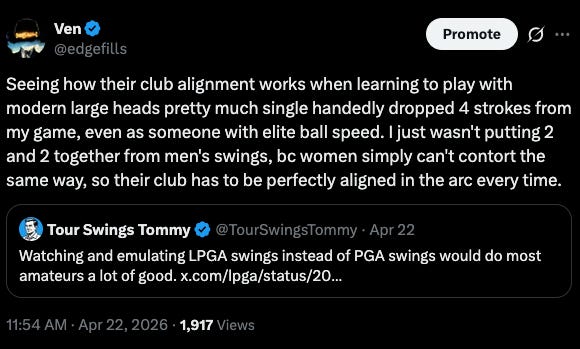
But as someone who suddenly found themselves capable of hitting a 7 wood ~250 carry after getting back into golf, there was no real way for me to lose from the ~6700 yard tees to a 19 year old girl. And on hole 7, I was pretty comfortable that, at my skill level, I should be able to give my friends a fair few strokes.
However, there’s one advantage a 19 year old girl has over me — they can’t drink. When we caught up to the groups in front of us and the pace of play slowed down dramatically, I got bored, and broke my “no more than two beers in a round” rule (as my timing just gets completely shot if I go past that.) I proceeded to “int” away hole after hole and carded doubles I had no business making, and couldn’t wrest enough control over my body by hole 18 to make it all square. I lost to a 19 year old girl!
Annoyed with myself, I sobered up and played another 18 an hour later and dropped those 6 strokes. But the damage to my ego was done, and I realized that the boredom that has been plaguing my “retirement” was also rushing my game and wrecking my score.
The following day, I went to Coyote Springs which was truly in the middle of nowhere.
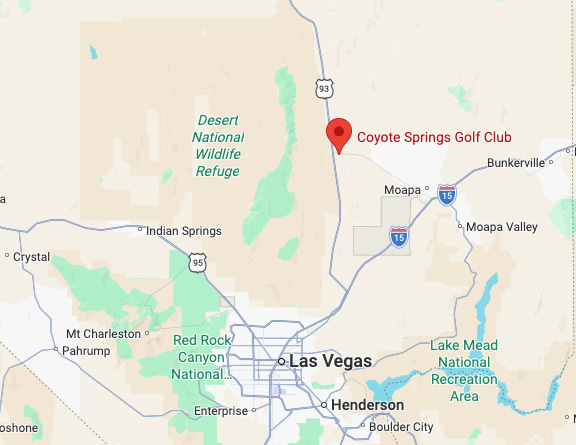
It’s probably the toughest course I’ve ever played, having played quite a few 140+ slope courses. Mr. Nicklaus truly decided to bring me down a peg after I crushed the Lake Powell course. Hitting my approaches into those greens felt like taking a final in the wrong classroom. It’s definitely a course where you’ll play it once and be in mental anguish trying to hit shots, and then once you get some knowledge of how the greens work, you’ll still putt a ball off it the next time out. I was instantly addicted, and it probably revealed what my biggest skill transfer from the trading world is. I could sense the frustration in my playing partners, with one guy’s wife losing it (honey, I would be struggling to break 90 on that course, what are you so upset about), but I can’t possibly get frustrated playing golf beyond an occasional line after a shot. I’m outdoors, playing a game, focusing, and enjoying life. Being tilt-proof in sports is a rare ability, but being tilt-proof when sums of money are being gambled is the next level of calculation and pressure. If I control for how those five-figure bets are peppered, into a market rather than onto a green, I’m confident my mental game is just as good as Scheffler’s.
When I got to the Aria, I decided to play some blackjack while waiting for my room. Within 3 shoes, I made double my greens/hotel fees, far surpassing my original poker goal. The responsible thing to do was quit while ahead, so I did. I’m still figuring out how to fill up my time, but “logging off” just means that I get to take all my acquired skills and manage the geometric drift of my life using the same principles.